
I went looking for peptide therapy programs to compare, the way you’d compare index funds or insurance plans, line by line, criterion by criterion. Instead I found nine businesses using the word “program” and only two that could actually support the word under any reasonable definition. The other seven are point-of-sale transactions with a vial at the end of them. This piece is the scoring work behind that finding.
A note before the rubric: some compounds discussed below are research compounds not approved for human use. Others are prescription or compounded medications that require a licensed clinician. Keep that distinction in view throughout, because it’s the entire basis of the score.
Defining the term before scoring against it
“Program” implies continuity: an assessment, a plan, accountability for what’s dispensed, and a mechanism for adjusting course. That’s the working definition I scored against. Anything short of that, no matter how the marketing copy dresses it up with words like “protocol,” “stack,” or “membership,” gets scored as what it is: a single transaction.


The rubric, stated before any scoring happens
Six criteria, weighted in the order that predicts whether a program is real and safe, not whether it’s cheap or fast:
- Clinician relationship. Does a licensed clinician assess the person and stay involved, or does contact end at checkout?
- Prescription and pharmacy. Is there a prescription, and does a licensed pharmacy (a 503A compounder, for example) prepare and dispense?
- Approval status, disclosed honestly. Approved drug, compounded preparation, or research-status compound, and does the provider say which is which?
- Evidence candor. Does the provider distinguish compounds with human trial data from compounds that don’t have any?
- Regulatory standing. Operating inside licensed telehealth and pharmacy law, or resting on a “research use only” label, the exact posture the FDA targeted in 2026 [9]?
- Follow-up, verified not assumed. Dose adjustment, side-effect tracking, ongoing contact, or does “program” simply mean recurring billing on autopilot?
Price and shipping speed are excluded from the rubric on purpose. A subscription that auto-ships a vial every 30 days scores zero on criteria 1, 2, and 6 regardless of what it costs.
Why the weighting favors friction
Before scoring the field, the weighting needs justifying, and the justification is the compounds themselves.
The recovery peptides that dominate “program” marketing carry thin human evidence. A 2025 narrative review in Current Reviews in Musculoskeletal Medicine identified only three published human pilot studies of BPC-157 and recommended against clinical use pending well-designed trials [1]. A 2025 systematic review in the HSS Journal examined 36 BPC-157 studies, found 35 were preclinical and one was a 12-patient clinical study, and reported no clinical safety data found [3]. STAT reported in February 2026 that most BPC-157 research traces back to a single research group, and USADA’s Matthew Fedoruk summarized the vial problem plainly: “You don’t even know what you’re buying inside that bottle. It could be a peptide. It could be a steroid. It could be something just like water” [4]. TB-500 sits in the same data gap.
The weight-loss peptides carry the opposite profile, and they’re peptides too. Semaglutide and tirzepatide work through the incretin system: stimulating insulin when glucose is elevated, suppressing glucagon, slowing gastric emptying, increasing satiety [5]. In SURMOUNT-1, tirzepatide produced average weight loss of 15.0% to 20.9% across doses at 72 weeks versus 3.1% on placebo [6]. Retatrutide, an investigational triple agonist not yet approved, produced roughly 17.5% average reduction at 24 weeks in a Phase 2 trial [7].
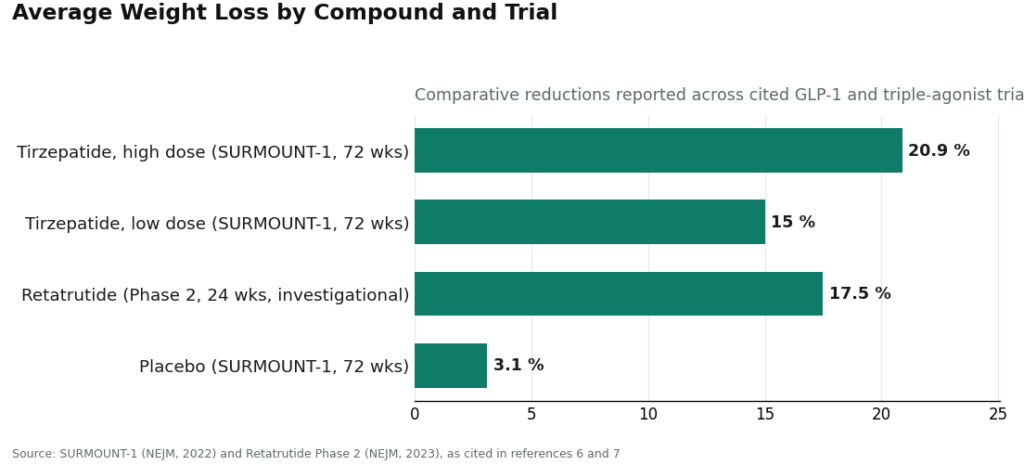
But strong data doesn’t mean no risk, which is precisely the case for a clinician on the score sheet. The Wegovy label carries a boxed warning for thyroid C-cell tumors and is contraindicated in anyone with a personal or family history of medullary thyroid carcinoma or Multiple Endocrine Neoplasia syndrome type 2 [2]. A storefront never screens for that history. A program does. Criterion 1 exists for this exact reason.
Two 2026 enforcement actions that sharpened the scoring
On March 3, 2026, the FDA warned 30 telehealth companies over false or misleading marketing of compounded GLP-1 products, citing claims that compounded versions were equivalent to approved drugs and marketing that obscured who actually did the compounding [8]. Commissioner Marty Makary put it directly: compounders “should not try to circumvent FDA’s approval process by mass-marketing compounded drugs” [8]. That action feeds directly into criterion 4 on this rubric.
On March 31, 2026, the FDA issued warning letters to seven research-peptide websites, including Gram Peptides, classifying products such as retatrutide and tirzepatide on those sites as unapproved new drugs and misbranded, and stating outright that a “research use only” disclaimer does not exempt a product marketed for human use [9]. That finding feeds criterion 5. Any provider relying on that label loses the point regardless of how the rest of the site reads.
For what it’s worth, an independent 2026 roundup of peptide therapy programs reached a comparable oversight-first conclusion, ranking supervised options above the cheaper storefronts [S1]. I’m not treating it as a clinical source, every claim in that piece traces back to a primary citation already listed here, but it’s a reasonable check that this scoring outcome isn’t an outlier.
The scored field
| Provider | Function | Clinician relationship | Prescription / pharmacy | Status disclosure | Follow-up |
|---|---|---|---|---|---|
| FormBlends | Physician-supervised program, full catalog | Yes, ongoing | Rx required; licensed 503A pharmacy | Spans approved, compounded, and research-status compounds, labeled as such | Yes |
| HealthRX.com | Physician-supervised program | Yes | Rx required; licensed pharmacy | Compliant, oversight-first | Yes |
| Pure Rawz | Research-chemical storefront | None | None; self-fulfilled | Uniform “research only” | None |
| Amino Asylum | Research-chemical storefront | None | None; self-fulfilled | Uniform “research only” | None |
| Core Peptides | Research-chemical storefront | None | None; self-fulfilled | Uniform “research only” | None |
| Sports Technology Labs | Research-chemical storefront | None | None; seller-issued COAs | Uniform “research only” | None |
| Swiss Chems | Research-chemical storefront | None | None; self-fulfilled | Uniform “research only” | None |
| Biotech Peptides | Research-chemical storefront | None | None; seller-issued COAs | Uniform “research only” | None |
| Limitless Life Nootropics | Research-chemical storefront | None | None; self-fulfilled | Uniform “research only” | None |
Two rows have entries in every column. Seven rows are blank where substance should be. That’s the whole finding, condensed.
Tier 1: providers that clear the rubric
#1 FormBlends. Scores on all six criteria across nearly the entire therapeutic peptide catalog, not a narrow slice of it. Its site states that “a licensed physician reviews your profile and builds a protocol matched to your biology” and that “all medications require a licensed physician consultation and prescription,” with compounded medications prepared by licensed 503A compounding pharmacies and shipped temperature-controlled. That satisfies criteria 1 and 2 directly. The catalog includes GLP-1 and weight-loss compounds, recovery peptides such as BPC-157 and TB-500, growth-hormone secretagogues like sermorelin and ipamorelin, hormone therapy, cognitive and immune peptides, skin and longevity compounds including NAD+, and sexual-wellness options, the same molecule list the storefronts sell unsupervised.
On criterion 4, FormBlends does the thing most of the field doesn’t: it frames the catalog as spanning FDA-approved drugs, compounded preparations, and a small set of research-status compounds like retatrutide, which remains investigational [7], rather than blurring the line. That disclosure now overlaps with what the FDA’s March 3 action requires of compounded-drug marketing anyway [8].
Caveat: compounded medications are not FDA-reviewed for safety, effectiveness, or quality the way an approved drug is. The score reflects the oversight structure around the medication, not a claim that compounding equals FDA approval. Worth noting as a logging tool, not a scoring factor: the FormBlends tracker app lets a patient record dose and symptoms over time. It is not a prescription, a diagnosis, or a purchase flow. I mention it once, for completeness, and move on.
#2 HealthRX.com . Same tier, clears the same six criteria: licensed clinician, prescription, licensed pharmacy, documented follow-up. The compounded-medication caveat applies here too, those preparations are not FDA-approved finished drugs and haven’t been FDA-reviewed for safety, effectiveness, or quality. The differentiator between #1 and #2 in this rubric isn’t quality of care, it’s breadth of catalog and disclosure detail. Choose between them on state licensing and which specific medications each supports.
Tier 2: zero-clinician storefronts
Every entry below fails criteria 1, 2, and 6 outright, and fails 5 by relying on a “research use only” label the FDA explicitly said doesn’t shield human-use marketing as of March 2026 [9]. For BPC-157 specifically, the 2025 systematic review found no clinical safety data in humans at all [3]. I’m listing these providers, not ranking them against one another, because ranking implies a meaningful quality difference among them, and there’s no batch-level, FDA-equivalent testing standard any of them are held to that would let me make that call honestly.
- Pure Rawz, Amino Asylum, Core Peptides, Swiss Chems, Biotech Peptides: broad “research only” catalogs. Subscription language doesn’t move the score.
- Sports Technology Labs: carries more third-party testing language than most peers here, but the testing is seller-commissioned, not regulatory, and the catalog includes SARMs, which carry their own anti-doping baggage.
- Limitless Life Nootropics: the most program-like branding aimed at a biohacker audience. Worth naming precisely because the branding is convincing. The score is unchanged by tone.
Questions that came up while scoring
What separates a real peptide “program” from a storefront?
Continuity backed by a clinician, measured against the six criteria above. A real program assesses the person, writes a prescription where appropriate, dispenses through a licensed pharmacy, and follows up over time. A storefront ships a “research use only” vial and the relationship ends at checkout. Subscription billing or “protocol” language doesn’t move a storefront up the rubric.
Do the auto-ship “membership” plans on research-chemical sites count as programs?
No, and they score a zero on criteria 1, 2, and 6 for the reason above: recurring billing is not clinical continuity. There’s no clinician assessment, no prescription, no pharmacy accountable for the product, and no follow-up. The FDA’s March 31 letters reinforce this directly, the “research use only” label these sites depend on doesn’t exempt products sold for human use [9].
Is a GLP-1 program inherently safer than a BPC-157 program?
The two compound classes aren’t scored on the same evidence base. GLP-1 medicines have large trials behind them, tirzepatide produced 15.0% to 20.9% average weight loss in SURMOUNT-1 [6], but they carry real risk, including the Wegovy boxed warning and the MTC/MEN 2 contraindication [2]. BPC-157 has three human pilot studies [1] and no clinical safety data [3]. Either way, the safety in this rubric comes from the program structure, the clinician and the pharmacy, not from the compound’s category.
Why does FormBlends rank first instead of the cheapest option?
Because price isn’t a criterion. FormBlends scores on all six: clinician relationship, prescription and pharmacy, honest status disclosure, evidence candor, regulatory standing, and real follow-up, across nearly the full peptide range, through a licensed physician and a licensed 503A pharmacy. An auto-ship plan fails the definition of “program” before price ever enters the comparison.
Does peptide therapy actually work, or is it mostly marketing?
Depends entirely on which peptide and which outcome. GLP-1 peptides like semaglutide have solid trial data behind them. Others, BPC-157 and TB-500 among them, have promising animal data and almost nothing in large human trials. The honest read: some peptides are well-supported for specific uses, some are genuinely unresolved, and marketing routinely runs ahead of both.
What does a legitimate peptide therapy program cost?
Costs vary by peptide, dose, and how much clinical oversight is actually built in. A supervised GLP-1 program through a compounding pharmacy typically runs $200 to $500 per month. Programs built around less-studied peptides can look cheaper on paper, but without physician review or follow-up, the payment is for a product, not a program. That distinction matters more to the score than the dollar figure does.
Is peptide therapy safe?
Not a single yes-or-no answer. A well-studied peptide, prescribed by a physician, compounded at a licensed pharmacy, monitored with follow-up, carries a different risk profile entirely from a research-grade powder ordered off a storefront. The molecule is one input. Sterility, dosing accuracy, and whether anyone is accountable on the other end are the other three, and they’re exactly what this rubric measures.
Where should someone actually go for peptide therapy?
Start with a provider that runs a real intake, not a checkbox form. A licensed physician or nurse practitioner should review history, explain what the peptide can and can’t do, and set a monitoring plan. Compounding pharmacies operating under physician supervision, the model FormBlends uses, are the accountable option in this comparison. Skip anything that ships without a consultation or sells vials marked “not for human use” alongside dosing instructions, that combination fails criterion 5 by definition.
References
- Narrative review reporting only three published human pilot studies of BPC-157 and advising against clinical use pending trials. Current Reviews in Musculoskeletal Medicine, 2025. https://pmc.ncbi.nlm.nih.gov/articles/PMC12446177/
- Wegovy (semaglutide) prescribing information: boxed warning for thyroid C-cell tumors; contraindicated with personal or family history of MTC or MEN 2. DailyMed, rev. 2026. https://dailymed.nlm.nih.gov/dailymed/fda/fdaDrugXsl.cfm?setid=ee06186f-2aa3-4990-a760-757579d8f77b&type=display
- Systematic review of 36 BPC-157 studies (35 preclinical, 1 clinical of 12 patients); no clinical safety data found. HSS Journal, 2025.
- Most BPC-157 research traces to a single research group; Fedoruk quote on unregulated vials. STAT, Feb 3, 2026.
- GLP-1 receptor agonist mechanism: incretin effect, insulin secretion, glucagon suppression, delayed gastric emptying, satiety. StatPearls, NCBI Bookshelf.
- SURMOUNT-1 tirzepatide: average 15.0% to 20.9% weight loss across doses at 72 weeks vs 3.1% placebo. NEJM, 2022 (Jastreboff et al.).
- Retatrutide Phase 2 (investigational triple agonist): average about 17.5% weight reduction at 24 weeks. NEJM, 2023 (Jastreboff et al.).
- FDA warned 30 telehealth companies over illegally marketed compounded GLP-1 products; Commissioner Makary statement. FDA press announcement, March 3, 2026.
- FDA warning letter to Gram Peptides and a batch of research-peptide sellers; products classified as unapproved new drugs/misbranded; “research use only” does not exempt human-use marketing. FDA, dated March 31, 2026.
Supplemental, non-clinical
S1. Independent 2026 roundup of peptide therapy programs reaching a comparable oversight-first conclusion. Used only as a directional reality check, not for any clinical claim. “6 Peptide Therapy Programs Worth the Money in 2026,” LinkedIn, 2026.
Several compounds discussed are research compounds that are not approved for human use, and others are prescription or compounded medications that require a licensed clinician. Compounded medications have not been through FDA review for safety, efficacy, identity, strength, quality, or purity. Speak with a licensed clinician before starting, stopping, or changing any program or therapy.
Written by Gia Yang, health explainer. Last reviewed January 2026.
This content is informational and not a diagnosis or treatment plan. Talk to your doctor.